This guide cross-checks manufacturer specifications and manuals, Korean-market prices, independent measurement-based reviews, and public rating signals as of August 30, 2026. When reviews disagreed, we examined usage and test conditions instead of averaging the results. There are no affiliate links, sponsorships, or supplied products. Health metrics are not for medical diagnosis.
1. The 30-second answer
These are not the same watch sold at two different prices.
- Redmi Watch 5 offers a large AMOLED display, built-in GNSS, long claimed battery life, and Bluetooth calling for ₩129,800 in Korea. It is a strong entry-level option for logging routes and distance while handling everyday notifications.
- Garmin Forerunner 265 was available for ₩459,000, about ₩329,200 more. The premium mainly buys multiband GPS, more dependable running data, Training Readiness, HRV Status, Acute Load, Recovery Time, detailed workout construction, and Garmin’s broader running ecosystem.
The decision rule is simple: choose Redmi if the goal is to keep a record. Choose Garmin if the record will guide today’s training intensity and preparation for the next race.
| One-sentence question | If the answer is “yes” |
|---|---|
| Do you run once or twice a week and need only a map, time, and approximate pace? | Redmi Watch 5 |
| Will you use interval targets, training load, and recovery status every week? | Forerunner 265 |
| Is taking calls from your wrist important? | Redmi Watch 5 |
| Would GPS or heart-rate error lead to a bad training decision? | Forerunner 265 |
| Do you require offline maps? | Neither |
If your goal is a first 5K finish and a record of the route, start with the Redmi Watch 5. If you run at least three times a week, use quality sessions, and are trying to improve a 10K or half-marathon time, the Forerunner 265 becomes a training tool rather than an expensive gadget. The 265 is now a previous-generation model after the Forerunner 570, so there is little reason to pay substantially more than the ₩459,000 reference price used here.
2. Define the exact products first
Xiaomi’s similar model names require care. This guide covers the standard REDMI Watch 5. It does not mix in the “Watch 5 Active,” which lacks GPS, or the differently specified “Watch 5 Lite.” Xiaomi Korea lists the standard model at 47.5 × 41.1 × 11.3 mm, about 33.5 g without the strap, with a 2.07-inch AMOLED display, five built-in satellite systems, and 5 ATM water resistance.
The Garmin comparison is the 46 mm-class Forerunner 265. The smaller 265S has almost the same features but differs in size, weight, and battery life. The 265 measures 46.1 × 46.1 × 12.9 mm, weighs 47 g, has a 1.3-inch AMOLED display and 5 ATM rating, and supports multiband GNSS.
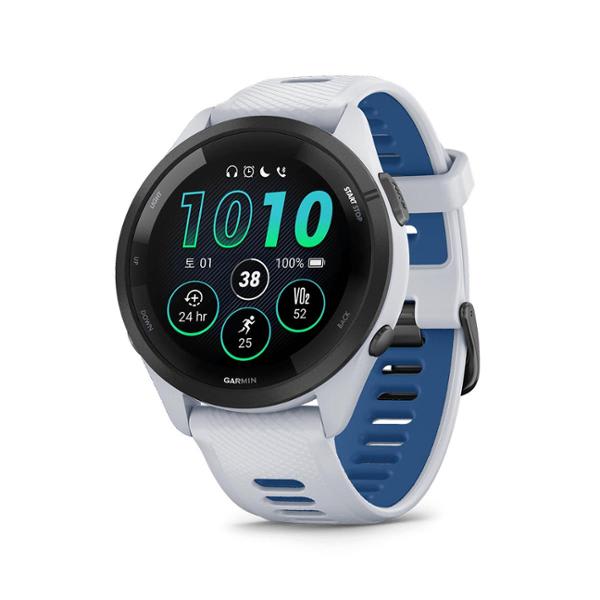
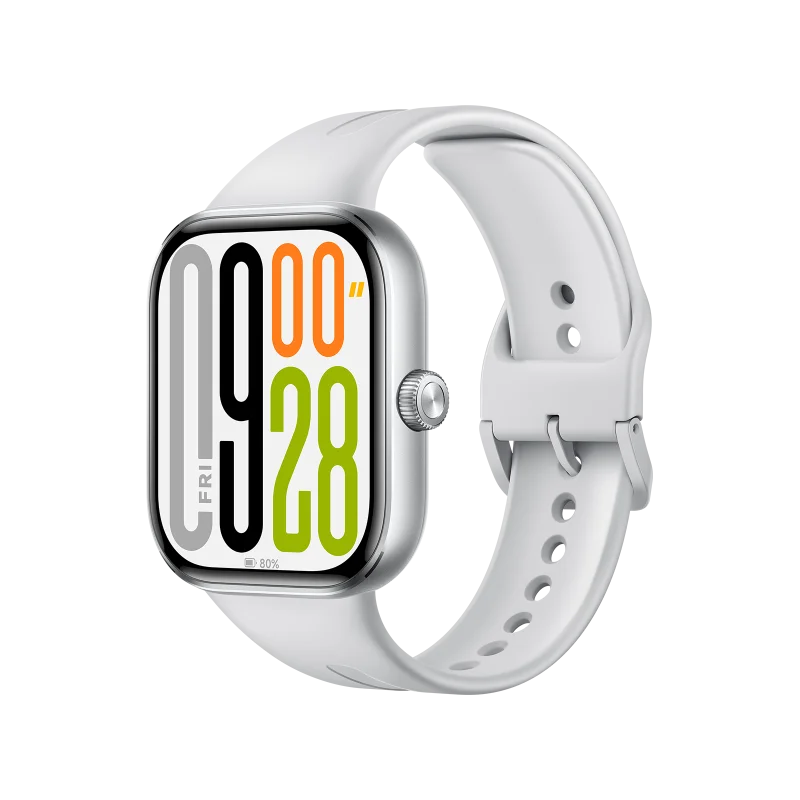
Official manufacturer images. They are not scaled to the watches’ actual relative sizes, so check case dimensions and, ideally, try them on. Sources: Garmin Korea and Xiaomi Korea.
| Item | Garmin Forerunner 265 | Standard REDMI Watch 5 | Buying impact |
|---|---|---|---|
| Verified Korean price | ₩459,000 | ₩129,800 | Difference: ₩329,200 |
| Display | 1.3 in, 416×416 AMOLED | 2.07 in, 432×514 AMOLED, 1,500-nit HBM | Redmi leads for size and calling |
| Weight | 47 g | About 33.5 g without strap | Test conditions differ, so compare carefully |
| Positioning | Includes multiband GNSS | GPS, Galileo, GLONASS, BeiDou, QZSS | Garmin is more dependable in difficult environments |
| Training analysis | Training Readiness, HRV Status, Acute Load, Recovery Time, and more | Basic activity features, Vitality, and 10 running courses | Garmin leads for goal-oriented training |
| Calling | No speaker or microphone | Bluetooth calling | Redmi is the stronger everyday smartwatch |
| Music | Offline playback from supported streaming services | Music transfer from Android; 164 MB storage listed | Both can work without a phone, with different scope |
| Water rating | 5 ATM | 5 ATM | Suitable for swimming; separate cautions apply to diving and saunas |
| Offline maps | None | None | Look at other models for unfamiliar-trail navigation |
3. Current prices and what the ₩329,200 gap means
The Forerunner 265 launched in Korea at ₩589,000 and had a verified price-comparison listing of ₩459,000 on August 30, 2026. Xiaomi Korea listed the REDMI Watch 5 at ₩129,800. Color, stock, coupons, and card promotions can change the checkout price, so treat these figures as decision reference points, not permanent prices.
Dividing the ₩329,200 gap by two years of running makes the tradeoff easier to see. At three runs a week, that is roughly 312 sessions and an added ₩1,055 per run for the Forerunner 265. At one run a week, it is about ₩3,165 per run.
Formula: (₩459,000 − ₩129,800) ÷ (3 runs a week × 52 weeks × 2 years) ≈ ₩1,055 per run
This does not mean the Forerunner 265 automatically makes anyone faster. The per-run premium matters only to someone who will act on multiband GPS, recovery, and load data. If you will not use the data, the entire ₩329,200 is wasted.
4. The biggest differences in running data
GPS: dependable pace matters more than the satellite count
The REDMI Watch 5 has built-in GNSS, so it can log a route without a phone. For distance and route tracking in an open park or riverside path, that meets an important requirement for an entry-level watch.
The harder cases are streets between tall buildings, dense tree cover, sharp turns, and intervals where instantaneous pace errors grow. The Forerunner 265 supports multiband positioning, and two independent reviews highlighted GPS or overall accuracy. In SELF’s month-long test, the watch agreed with a marked 0.5-mile point and usually finished familiar loops within roughly 0.01–0.02 mile of prior measurements. That is one reviewer’s result on specific routes, not a guarantee for every environment, but its direction is consistent with the other evidence.
REDMI Watch 5 results conflict. Gadgets & Wearables viewed its GPS and basic tracking positively, while Wareable observed over-recorded distance, off-course notifications, and pace and peak heart-rate readings above a dedicated comparison device. When independent results conflict, matching the product to the more conservative use case is safer. The Redmi is therefore reasonable for recording routes and activity volume, but it deserves caution for 400 m repeats or strict target-pace decisions.
Heart rate: viewing a number is different from setting intensity with it
Wrist optical heart rate is affected by skin, fit, wrist movement, cold, and exercise type. Neither watch is a medical device. If precise zone training during hard intervals matters, a chest strap is generally the better measurement tool.
Watch choice still matters. Wareable reported that exercise and everyday heart rate on the REDMI Watch 5 tended to run high versus comparison devices. The Forerunner 265 did not show abnormal drops during intervals in SELF’s test, and Wareable also treated overall accuracy as a strength.
The Redmi can be useful when heart rate is simply a record. If you speed up or slow down by heart-rate zone or interpret recovery from the readings, the evidence is firmer for the Forerunner 265.
Training analysis: this is where Garmin earns—or loses—its value
Training Readiness on the Forerunner 265 combines sleep score, recovery time, HRV Status, Acute Load, recent sleep, and stress history. Training Status uses VO₂ max, Acute Load, and long-term HRV changes. These metrics are not absolute truth, but the system connects one run to the next training decision.
The REDMI Watch 5 lists more than 150 sport modes and 10 running courses, yet independent reviews confirm that HRV and deeper recovery metrics are absent. A high count of activity modes does not equal depth in running analysis.
5. Battery numbers need context
Manufacturer claims say 24 days of typical use for the REDMI Watch 5 and up to 13 days in smartwatch mode for the Forerunner 265. The test conditions differ. Xiaomi’s 24-day scenario disables high-precision sleep monitoring, sleep breathing monitoring, all-day stress, and all-day blood oxygen, while limiting weekly workout recording to 90 minutes. Garmin also notes that notifications, wrist heart rate, and other settings change actual endurance.
GPS modes matter more for a running watch. Garmin specifies 20 hours for GPS-only, 16 hours for Auto Select, 14 hours for All Systems plus multiband, and 7 hours for GPS with music. Xiaomi Korea does not publish a directly comparable continuous-GPS figure. In Wareable’s REDMI test, a 30-minute outdoor workout used 6%, and the reviewer estimated about a week under heavier GPS or always-on-display use. One session is not enough evidence to extrapolate that 6% into exactly 8 hours and 20 minutes.
6. What independent reviews agree on
Ratings are satisfaction signals, not accuracy tests. On August 30, 2026, Danawa displayed 4.9 from 187 product reviews for the Forerunner 265. On August 31, Amazon’s standard REDMI Watch 5 page showed 4.5 from 2,574 ratings. The markets, retailers, buyer expectations, and dates differ, so we did not treat the scores as a performance ranking. We also did not collect or republish review text because of rights, duplication, and model-mixing risks.
Instead, we cross-checked at least two specialist reviews for each product.
| Product | Positive evidence | Repeated cautions | Evidence judgment |
|---|---|---|---|
| Forerunner 265 | GPS and heart-rate accuracy, rich running and recovery data, physical buttons, music | High price, initial learning curve, no ECG, calling, or offline maps | Running-performance assessments are relatively consistent |
| REDMI Watch 5 | Large display, light body, long battery, low price, built-in GPS and calling | Some reviews found distance over-reading, route drift, and high heart rate; deeper recovery data is absent | Strong basics, but exercise-accuracy findings conflict |
This does not make the REDMI Watch 5 a bad watch. Expecting Forerunner-level analysis from a ₩129,800 watch creates disappointment; buying a Forerunner 265 and checking only time and distance creates overspending.
The Forerunner 265 launched in 2023, and the Forerunner 570 arrived in 2025. Independent comparisons credit the 570’s speaker and microphone, brighter display, and newer sensor, while arguing that the higher price leaves the 265 as a strong midrange choice. When buying a 265 now, focus less on having the newest model and more on whether the discounted price and existing features are already sufficient.
7. Who should buy which watch
The REDMI Watch 5 is a good buy if you
- Are starting to run and do 30–60 minutes once or twice a week.
- Prioritize logging route, distance, and approximate pace without carrying a phone.
- Will often use the large display, notifications, and Bluetooth calling outside workouts.
- Cannot comfortably exceed a budget around ₩150,000.
- Can tolerate small heart-rate or instant-pace errors without derailing a training plan.
Under those conditions, keeping budget for shoes, injury prevention, and race fees may be more efficient than spending more on the Forerunner 265.
The Forerunner 265 is worth its price if you
- Run at least three times a week with a 10K, half-marathon, or marathon goal.
- Use lap pace and target-range alerts for intervals and tempo runs.
- Apply sleep, HRV, training load, and recovery time to the next workout’s intensity.
- Need dependable GPS between city buildings or under heavy tree cover.
- Plan to expand into chest straps, power meters, and a long-term training ecosystem.
At three runs a week over two years, the premium is roughly ₩1,055 per session. That is defensible if it changes weekly training decisions. If you expect to stop opening Garmin Connect after the first month, do not buy it.
If the decision is still stuck between the two
If you want Garmin’s GPS and running ecosystem but the 265 costs too much, check the Forerunner 165. Its verified Korean price-comparison listing was ₩249,000 in August 2026. It lacks multiband positioning, yet independent tests rated its GPS very highly. It also omits some of the 265’s advanced features, including Training Readiness and parts of the multisport feature set. It is worth checking for someone who needs a more accurate running watch than the Redmi but will not use the 265’s full training analysis.
8. Final pre-purchase checklist
- Confirm the model name: Match the listing and specification table to REDMI Watch 5, not Active or Lite.
- Check wrist fit: If the REDMI’s 2.07-inch rectangle or the Forerunner’s 46 mm case feels large, compare the 265S.
- Set a price ceiling: The 265 has a successor. If it costs substantially more than this guide’s ₩459,000 reference, compare the 570 and 165 again.
- Verify official distribution and warranty: Check domestic warranty, exchange, and repair terms before choosing the lowest parallel-import price.
- Write down only three must-have features: Ask whether features you will actually use—such as accurate GPS, Training Readiness, and intervals—exist only on the 265.
- Do not make medical decisions: Heart rate, SpO₂, and sleep values are wellness references. Seek medical care for symptoms or diagnosis.
- Consider a chest strap: If hard-effort heart-rate accuracy is critical, budget separately for a chest strap.
9. Sources and method
Official sources were used to confirm model identity, specifications, battery claims, and features—not to judge real-world performance. Performance judgments were kept separate and based on independent reviews. When reviews conflicted, we labeled the disagreement as buying risk instead of averaging toward the favorable result. Prices and ratings are changeable snapshots, and only aggregate signals were checked; original user-review text was not scraped or republished.
Official and primary sources
- Garmin Korea Forerunner 265 product page Exact model and core features
- Garmin Korea launch release Korean launch price and timing
- Garmin Forerunner 265 battery manual Official battery figures by mode
- Garmin Training Readiness manual Inputs to the score
- Xiaomi Korea REDMI Watch 5 specifications Dimensions, weight, display, GNSS, and storage
- Xiaomi Global REDMI Watch 5 product page and test conditions Internal conditions behind the 24-day battery claim
Prices and market signals
- Danawa: Forerunner 265 Price and aggregate product-review signal checked 2026-08-30
- Xiaomi Korea official purchase page Official displayed price checked 2026-08-30
- Amazon: REDMI Watch 5 Public rating and count on the standard-model product page checked 2026-08-31
Independent reviews
- Wareable: Garmin Forerunner 265 review GPS, interface, battery, and limitations
- SELF: Garmin Forerunner 265 one-month review One month of wear, distance, heart rate, and training features
- Wareable: REDMI Watch 5 review GPS and heart-rate comparison, battery observations
- Gadgets & Wearables: REDMI Watch 5 review Contrasting GPS assessment and feature scope
- Wareable: Forerunner 570 vs 265 The 265’s value after its successor
If you find an error or price change, revisions are tracked against the source URL and verification date.